

In the Viewpoint column of PBM’s January 2026 issue, editor Paul Davies looks back on a rather dismal 2025 but reflects more positively on the broader direction of travel for the industry as we head into the new year.
A very warm welcome to the first PBM issue of 2026 and I sincerely hope you had a wonderful Christmas and enjoyed the New Year festivities. Doubtless well deserved, as I’m absolutely certain we are all relieved to put 2025 behind us. What an awful year.
Yes, so much for the mantra from a couple of years back of ‘survive ‘til 2025’, awaiting the inevitable cyclical uptick that would kick everything back into gear. The previous time a new Labour Government was elected, they told us: ‘Things can only get better.’ How times have changed…
Looking back at my column from 12 months ago, I could have saved everyone a lot of trouble by just re-running the whole thing. Sample quote from Jan 2025: “Unforced errors and a long wait until the autumn Budget engendered a somewhat surreal sense of limbo, then only made worse by the reaction to some of Chancellor Rachel Reeves’ proposals.”
Or consider: “Many merchants and suppliers alike have stated that these decisions are forcing them to reconsider previous plans to invest in people and plant…”
And for balance: “To offer a more optimistic view, Government rhetoric on the importance of the construction industry as both an engine for growth and a pathway to improving living standards remains strong.”
Plus ça change indeed. In so many ways, 2025 was at best a wasted year. We largely still await action to match the pronouncements, but have to take solace that the underlying conditions — a general shortage of housing and the necessity of upgrades to the existing stock, to name just two key factors — demand that the tanker must turn soon.
“We’re regularly using language and outlining concepts that were barely acknowledged even a few short years ago, but are now increasingly business essentials.”
One final caveat here. Last January presented yet another year of missed opportunities, and I concluded with the following: “I have an alarming sense of déjà vu about much of what I have written above. One can only hope that this time next year, we’ll be reflecting on a period of frenetic activity that delivers increased sales and profits, all supported by growing teams of eager new recruits.”
I was dramatically wrong, but if the picture remains unchanged in 12 months hence, I’m running this exact column again. Word-for-word…
Moving on, then. I rarely delve into too much detail here about the stories we cover later in the issue (that is what the Contents page is for!) but on signing the pages off for this edition, it is striking that what has changed over the last couple of years are the huge leaps forward in some of the subjects we discuss.
Technology, and how innovation can drive efficiencies in areas such as stock management, sales optimisation or transport management, have always been a key focus. Indeed, digitisation has been high on the agenda for some time, not least buoyed by the rapid adoption of new methodologies necessitated by Covid (incredibly, now almost six years since our first encounter with ‘the coronavirus’…).
Yet whilst the broader principles hold true, our pages now peppered with missives on AI integrations and data management; of cyber security and automated credit checks; digital recruitment portals, advanced visualisation software and sophisticated transport management systems.
We’re regularly using language and outlining concepts that were barely acknowledged even a few short years ago, but are now increasingly business essentials. And let’s not forget the offline advances either — ever-more refined branches, and just look at this month’s cover story for one example of enhanced customer service concepts.
Of course, too many have sadly been defeated by the sustained downturn. But in general terms, for all the stagnation in the wider economy, the merchant sector has simply refused to stand still.
And whilst it may not be positively impacting the bottom line just yet, the readiness for that brighter future is looking promising.
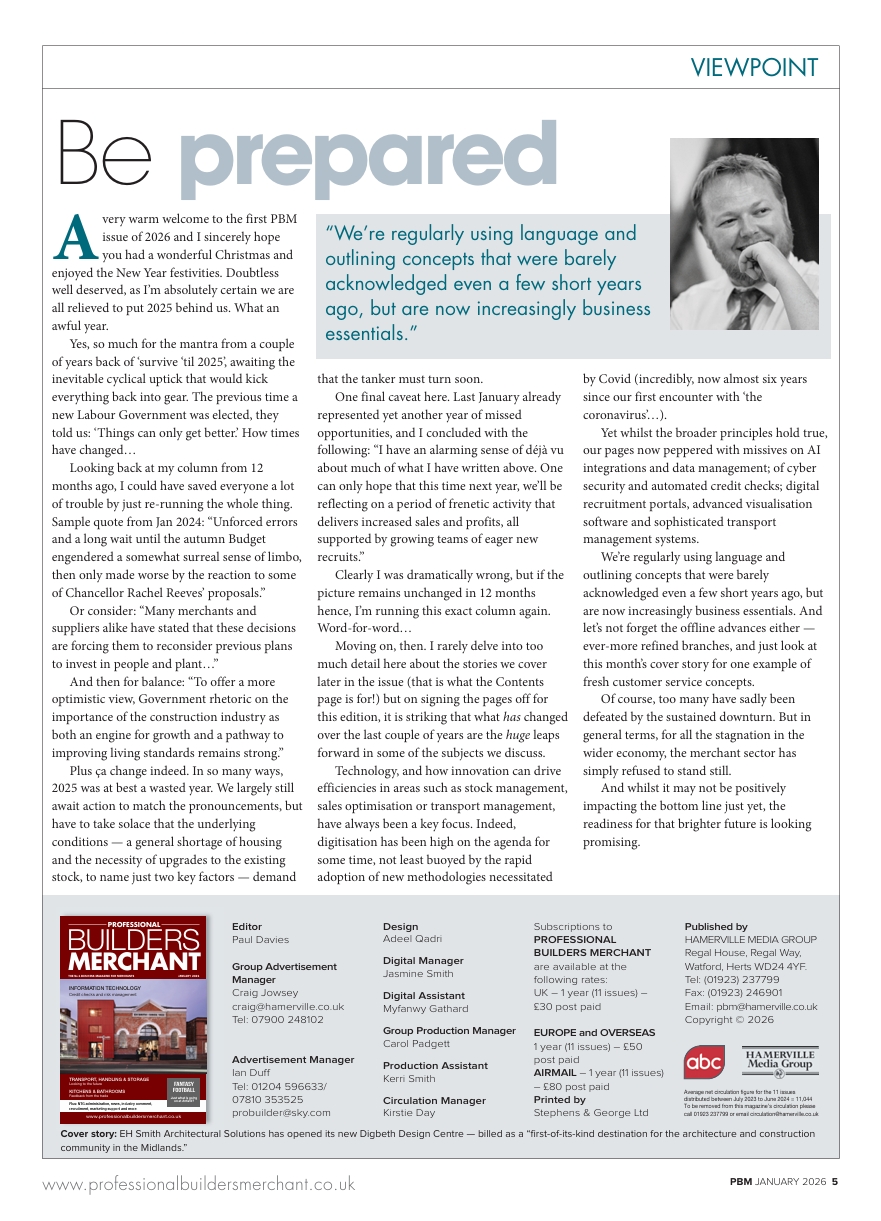
Cover story: EH Smith Architectural Solutions has opened its new Digbeth Design Centre — billed as a “first-of-its-kind destination for the architecture and construction community in the Midlands.”