

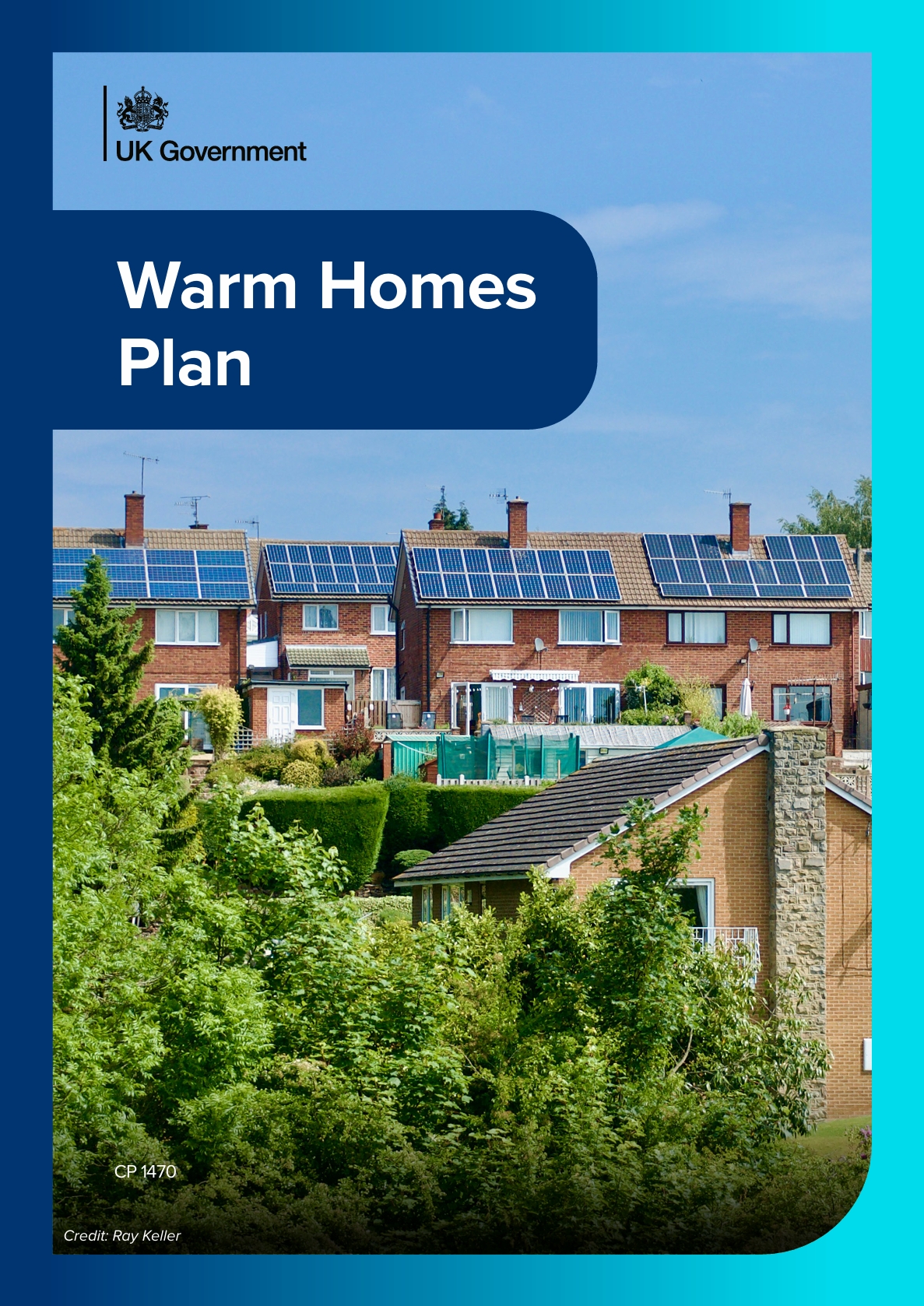
After much delay, the Government has now launched the £15 billion ‘Warm Homes Plan’ which it states is designed to “help millions of families benefit from solar panels, batteries, heat pumps and insulation that can cut energy bills.” PBM presents a number of responses to the proposals from across the construction industry including merchants, manufacturers and trade organisations (with the BMF perspective detailed separately here):
Wolseley UK / Renewables Centre
Dan Marsden, Director of Renewables at Wolseley, said: “Our recent report highlighted the need for a clear, long-term strategy that will underpin home decarbonisation. The Warm Homes Plan delivers this direction, providing the certainty and confidence the sector needs to keep investing in the workforce and supply chain required to scale low carbon heating across the UK.
“Plans to both simplify heat pump installations and target install times of no more than three days from the day of consumer signature are welcome, and we are already helping to support these ambitions by simplifying delivery and installation at scale through our Renewables Centre.
“At Renewables Centre, we are focused on building the skills base for the future through MCS accredited training, while supporting a renewables sector that prioritises high-quality installations and consumer confidence. The Warm Homes Plan supports these ambitions and brings us closer to our target of training 5,000 new installers by 2030.
“We welcome the plan’s focus on installer training support, minimum energy efficiency standard uplifts, stronger consumer protections, and commitments to decarbonising new homes and buildings. Together, these measures will help create the conditions for a thriving renewables market. We also support the area-based delivery approach, which better reflects the diverse needs of the UK’s building stock and gives consumers greater flexibility depending on their property type.
“As demand for low carbon heating grows, building a skilled workforce, ensuring adequate financial support, and maintaining strong quality assurance will be essential to reducing bills and delivering warm, efficient homes. We will continue working with installers and consumers across the country to help deliver the UK’s energy transition.”
National Federation of Builders
CEO Richard Beresford said: “The Government’s Warm Homes Plan offers a broader set of solutions to tackle fuel poverty, and this is vital because too often past governments have treated insulation as a silver bullet. Yet if it is not done correctly, it creates health problems for homes and occupants.”
The programme has announced three pillars which Ed Miliband, Secretary of State for Energy, Security and Net Zero (DESNZ), described as follows:
Pillar One will offer direct support for low-income families;
Pillar Two creates financial incentives, such as low-cost loans, for renewable technologies such as solar panels and batteries, while sustaining the heat pump grants;
Pillar Three places a legal duty for landlords to ensure renters live in homes which meet minimum energy efficiency standards.
The Government expects the plan to create 180,000 future-proofed ‘green’ jobs by 2030. The outcomes and progress of the Warm Homes Plan will be overseen by a new agency called the Warm Homes Agency and further powers will be given to local mayors to roll out schemes in their areas.
Rico Wojtulewicz, Director of Policy and Market Insight, added: “More homes being insulated, and solar panels installed on roofs. Batteries are further supported so families can take advantage of lower cost energy where there is less demand on the grid, without the disadvantage of having to pay for wind turbines to be switched off. And heat pump grants have matured further to accept our recommendation to include the cheaper, quicker to install air-to-air systems.
“The Government are showing that they understand the decarbonisation challenge.”
He continued: “This challenge is substantial. We already know that new housing targets will be hindered by a grid which cannot deliver the Future Homes Standard plan to mandate solar panels, EV charging, and electric heating and cooking. With new build being less than 1% of stock, electrifying the remaining 99% is going to require a monumental set of planning reforms and grid investment.
“We have seen some of this already taking place; however, a wasted decade of ignored warnings is going to hinder this Government’s ambition. This is why industry must speak honestly to decision makers, while pushing back at detractors who see missed targets or barriers as evidence of failure and opportunities to criticise them. Decarbonisation needs solutions and conviction in its implementation, not party-political grandstanding.”
Daikin UK
Hamid Salimi – Head of Residential Products commented: “The Warm Homes Plan will accelerate progress towards net zero. It will make it cheaper to install and run low carbon heating, making heat pumps even more attractive, particularly when they are paired with solar PV and battery technologies.
“The ability to apply for a low or zero interest loan on-top of the Boiler Upgrade Scheme (BUS) grant is particularly welcome, as it will encourage more householders to invest in this technology. As hotter climate conditions become an increasing issue in the UK, we welcome BUS funding being extended to air-to-air heat pumps that can cool as well as heat homes.
He continued: “We also welcome the plan’s fully funded upgrades for low‑income households, helping ensure the shift to cleaner heating is fair and accessible for all. We would, however, urge the government to take early and decisive steps to reduce the price of electricity.
“This remains a barrier to the electrification of domestic, commercial and industrial heating.”
Head of Marketing Communications Daniel Redfern said: “The announcement of the Warm Homes Plan is, of course, to be welcomed, and the £15bn allocation to support energy performance improvements to UK housing stock will play an important role in helping the UK progress towards its Net Zero ambitions.
“Designed to support the overhaul of up to 5 million homes through the specification of renewable technologies, including solar panels on roofscapes, the plan will further accelerate efforts to improve home energy efficiency and help lower energy bills, especially in the social housing sector.
“The investment presents a tangible opportunity for local government and the housebuilding sector to opt for proven renewable energy solutions that can help deliver energy efficient and low carbon homes for tenants, as well as new and existing homeowners.
“The roofing sector will be central to the successful delivery of the Warm Homes Plan, with solar panels acknowledged to be a primary technology solution. However, it’s now important that there is an increased focus on upskilling the existing workforce as well as attracting new talent into the industry to ensure we have the workforce in place to implement the plan at scale, both on retrofit projects and new builds.
“We expect the Government’s financial commitment through the Warm Homes Plan will further incentivise the uptake of proven technologies that can help transform the energy efficiency performance of UK homes for the long term. As such, product supply will be central to the plan’s successful implementation, and it’s important that those specifying solar panels are choosing high quality solutions to ensure long-term performance. Marley has led the way by providing a fully roof integrated solar panel solution – Marley SolarTile® – designed specifically for pitched roofs, and available as part of a wider single source renewable technology package that includes connected battery storage and inverters.
“As more details around the plan are announced in due course, we look forward to working with those across the construction industry to play our part in ensuring its successful delivery.”
OFTEC / UKIFDA (UK and Ireland Fuel Distributors Association)
In a joint statement, OFTEC CEO Paul Rose and UKIFDA CEO Ken Cronin commented:
“We welcome the publication of the Warm Homes Plan and share the government’s ambition to deliver affordable, low carbon heating solutions to reduce both energy bills and carbon emissions for homes and businesses.
“Our focus remains on the off-grid sector where we continue to work positively with policymakers. The government recognises that there are challenges for these harder to treat properties, particularly upfront cost, and that alternative solutions may be needed.
“We are pleased the government is exploring a renewable liquid fuel solution as part of its Alternative Clean Heating consultation which closes next month. These fuels provide a low cost transition, and immediate carbon reduction, for properties that may struggle with other technologies.
“This isn’t just our view. In the past few weeks we’ve seen nearly 5,000 oil heated households, from Cornwall, Wales to Scotland, respond to this consultation in support of renewable liquid fuels. There is a clear appetite for this approach. Even today, dozens of oil heating users in the village of Kehelland in Cornwall are driving up to London to meet with policymakers to share their experience of using renewable liquid fuels.
“We are fully aligned with the government’s ambition that no household is left behind. That’s why we stand ready to help bolster the Warm Homes Plan to ensure it delivers a fair and inclusive transition for all homes and businesses.”
Dave Raval, Insulation Expert at LoftZone, and Director of the National Warm Homes Council said:
“The news that the Government is proceeding with the ineffective Warm Homes Plan is deeply troubling and risks repeating critical errors made previously. These plans had rightly been earmarked as a once-in-a-generation opportunity to firmly upgrade the UK housing market’s value. Unfortunately, overlook the basics such as protecting loft insulation through mandatory raised boarding.
“It is well known within our industry and beyond that the vast majority of households are damaging insulation, and by extent their energy efficiency and warmth, simply because they store items directly on top. In turn, it reduces effectiveness drastically by up to 50%, meaning homes leak energy, waste cash and work harder to keep warm for longer.
“Despite this, British SMEs such as LoftZone stand side-by-side with the Government’s aim to lower consumer energy bills. Many businesses have already developed their own affordable and accessible insulation protection, systems such as LoftZone’s StoreFloor raised boarding are inexpensive. An average installation costs just £1,500 or £500 to do it yourself.
“I am today calling on ministers to introduce further legislation which integrates these solutions and prevents previous mistakes from rearing their ugly head. Loft insulation remains an integral component within energy efficient households and adds a layer of protection, yet shockingly over 13 million still only meet 1976 standards – which can cost up to £380 on wasted energy each year.”
Becky Lane, CEO of retrofit company Furbnow:
“It’s great to see the government taking the need for warm homes seriously, but unfortunately the Warm Homes Plan falls short. Solar panels and batteries will cut electricity bills and heat pumps will help you create a low-carbon home, but if your home is already struggling to keep heat in, then this loan does not help improve your home insulation and keep you warm.
“We constantly speak to homeowners who are renovating or looking to fix their cold home, worried about making the jump to a heat pump or solar panels when their home can’t keep heat any in. Insulation is the missing piece, and with the Warm Homes Plan this is still too expensive.
“With loans focusing on technologies instead of the fabric, the Warm Homes Plan risks leaving behind millions of households who are not eligible for local grants. UK’s homes are old, leaky and inefficient, and until we fix that, people will continue to live in cold homes and pay more than they should.”
Commercial Technical Manager Neil Sawers commented: “The launch of the Warm Homes Plan is potentially a key moment for energy affordability across Britain and underlines this Government’s commitment to cleaner energy. The Plan’s three-pillar approach is welcome; direct support for low-income families, an offer of universal access to clean energy financing and meaningful protections for renters.
“Heat pumps are central to the new Warm Homes Plan and we are pleased about the continued focus on this proven and clean home heating solution. We will continue to work with industry as the Plan develops and we look forward to seeing the new Warm Homes Agency, which will be key to the Plan’s successful delivery, take shape.”