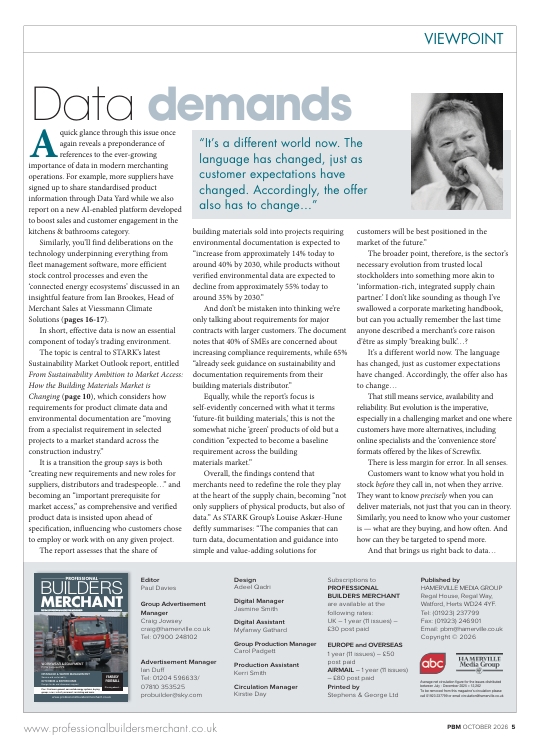


In the Viewpoint column of PBM’s October 2026 issue, editor Paul Davies discussed the increasingly vital topic of data management in the merchant sector…
A quick glance through this issue once again reveals a preponderance of references to the ever-growing importance of data in modern merchanting operations. For example, more suppliers have signed up to share standardised product information through Data Yard while we also report on a new AI-enabled platform developed to boost sales and customer engagement in the kitchens & bathrooms category.
Similarly, you’ll find deliberations on the technology underpinning everything from fleet management software, more efficient stock control processes and even the ‘connected energy ecosystems’ discussed in an insightful feature from Ian Brookes, Head of Merchant Sales at Viessmann Climate Solutions.
In short, effective data is now an essential component of today’s trading environment.
The topic is central to STARK’s latest Sustainability Market Outlook report, entitled From Sustainability Ambition to Market Access: How the Building Materials Market is Changing, which considers how requirements for product climate data and environmental documentation are “moving from a specialist requirement in selected projects to a market standard across the construction industry.”
It is a transition the group says is both “creating new requirements and new roles for suppliers, distributors and tradespeople…” and becoming an “important prerequisite for market access,” as comprehensive and verified product data is insisted upon ahead of specification, influencing who customers chose to employ or work with on any given project.
“It’s a different world now. The language has changed, just as customer expectations have changed. Accordingly, the offer also has to change…”
The report assesses that the share of building materials sold into projects requiring environmental documentation is expected to “increase from approximately 14% today to around 40% by 2030, while products without verified environmental data are expected to decline from approximately 55% today to around 35% by 2030.”
And don’t be mistaken into thinking we’re only talking about requirements for major contracts with larger customers. The document notes that 40% of SMEs are concerned about increasing compliance requirements, while 65% “already seek guidance on sustainability and documentation requirements from their building materials distributor.”
Equally, while the report’s focus is self-evidently concerned with what it terms ‘future-fit building materials,’ this is not the somewhat niche ‘green’ products of old but a condition “expected to become a baseline requirement across the building materials market.”
Overall, the findings contend that merchants need to redefine the role they play at the heart of the supply chain, becoming “not only suppliers of physical products, but also of data.” As STARK Group’s Louise Askær-Hune deftly summarises: “The companies that can turn data, documentation and guidance into simple and value-adding solutions for customers will be best positioned in the market of the future.”
The broader point, therefore, is the sector’s necessary evolution from trusted local stockholders into something more akin to ‘information-rich, integrated supply chain partner.’ I don’t like sounding as though I’ve swallowed a corporate marketing handbook, but can you actually remember the last time anyone described a merchant’s core raison d’être as simply ‘breaking bulk’…? *
It’s a different world now. The language has changed, just as customer expectations have changed. Accordingly, the offer also has to change…
That still means service, availability and reliability. But evolution is the imperative, especially in a challenging market and one where customers have more alternatives, including online specialists and the ‘convenience store’ formats offered by the likes of Screwfix.
There is less margin for error. In all senses.
Customers want to know what you hold in stock before they call in, not when they arrive. They want to know precisely when you can deliver materials, not just that you can in theory. Similarly, you need to know who your customer is — what are they buying, and how often. And how can they be targeted to spend more.
And that brings us right back to data…
* somewhat ironically, Tippers’ Bill Tipper actually did use this phrase mere days after this column was sent to press, during a panel session at the recent BMF Annual Members’ Conference. The broad point stands, given that the workshop was chaired by Data Yard and was entitled “Product data is holding the industry back (and) here’s how to turn it into growth,” with Bill asserting how the more effective use of data would be “an enabler, helping us get the right product to the right customer in a timely manner…” adding that “we’re a service business, so it is all about developing better ways to service customer needs.”