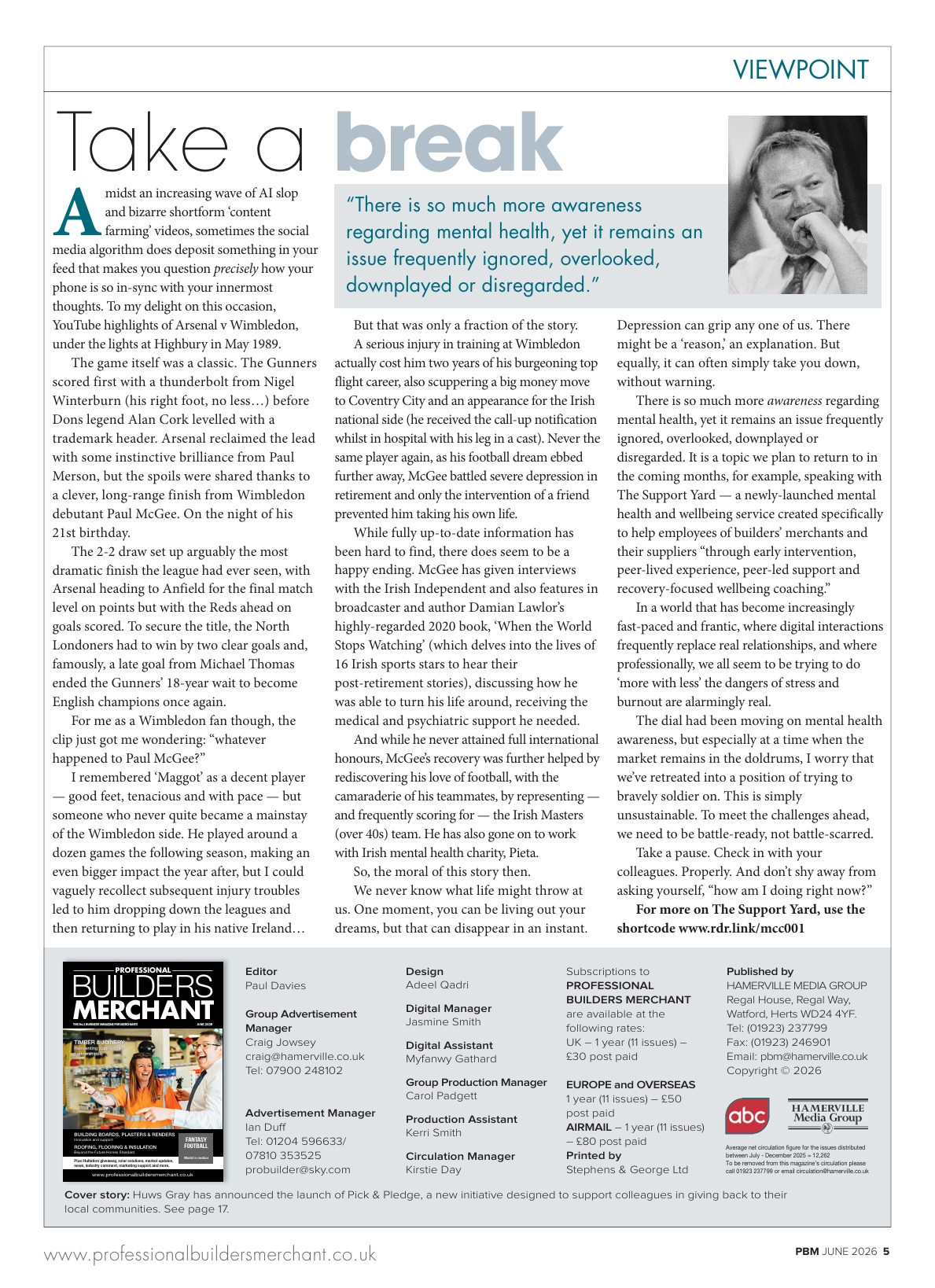


Writing in the Viewpoint column of PBM’s June 2026 issue, editor Paul Davies outlines his concerns that any growth in mental health awareness is still not being matched by meaningful support…
Amidst an increasing wave of AI slop and bizarre shortform ‘content farming’ videos, sometimes the social media algorithm does deposit something in your feed that makes you question precisely how your phone is so in-sync with your innermost thoughts. To my delight on this occasion, YouTube highlights of Arsenal v Wimbledon, under the lights at Highbury in May 1989.
The game itself was a classic. The Gunners scored first with a thunderbolt from Nigel Winterburn (his right foot, no less…) before Dons legend Alan Cork levelled with a trademark header. Arsenal reclaimed the lead with some instinctive brilliance from Paul Merson, but the spoils were shared thanks to a clever, long-range finish from Wimbledon debutant Paul McGee. On the night of his 21st birthday.
The 2-2 draw set up arguably the most dramatic finish the league had ever seen, with Arsenal heading to Anfield for the final match level on points but with the Reds ahead on goals scored. To secure the title, the North Londoners had to win by two clear goals and, famously, a late goal from Michael Thomas ended the Gunners’ 18-year wait to become English champions once again.
For me as a Wimbledon fan though, the clip just got me wondering: “whatever happened to Paul McGee?”
“There is so much more awareness regarding mental health, yet it remains an issue frequently ignored, overlooked, downplayed or disregarded.”
I remembered ‘Maggot’ as a decent player — good feet, tenacious and with pace — but someone who never quite became a mainstay of the Wimbledon side. He played around a dozen games the following season, making an even bigger impact the year after, but I could vaguely recollect subsequent injury troubles led to him dropping down the leagues and then returning to play in his native Ireland…
But that was only a fraction of the story.
A serious injury in training at Wimbledon actually cost him two years of his burgeoning top flight career, also scuppering a big money move to Coventry City and an appearance for the Irish national side (he received the call-up notification whilst in hospital with his leg in a cast). Never the same player again, as his football dream ebbed further away, McGee battled severe depression in retirement and only the intervention of a friend prevented him taking his own life.
While fully up-to-date information has been hard to find, there does seem to be a happy ending. McGee has given interviews with the Irish Independent and also features in broadcaster and author Damian Lawlor’s highly-regarded 2020 book, ‘When the World Stops Watching’ (which delves into the lives of 16 Irish sports stars to hear their post-retirement stories), discussing how he was able to turn his life around, receiving the medical and psychiatric support he needed.
And while he never attained full international honours, McGee’s recovery was further helped by rediscovering his love of football, with the camaraderie of his teammates, by representing — and frequently scoring for — the Irish Masters (over 40s) team. He has also gone on to work with Irish mental health charity, Pieta.
“To meet the challenges ahead, we need to be battle-ready, not battle-scarred.”
So, the moral of this story then.
We never know what life might throw at us. One moment, you can be living out your dreams, but that can disappear in an instant. Depression can grip any one of us. There might be a ‘reason,’ an explanation. But equally, it can often simply take you down, without warning.
There is so much more awareness regarding mental health, yet it remains an issue frequently ignored, overlooked, downplayed or disregarded. It is a topic we plan to return to in the coming months, for example, speaking with The Support Yard — a newly-launched mental health and wellbeing service created specifically to help employees of builders’ merchants and their suppliers “through early intervention, peer-lived experience, peer-led support and recovery-focused wellbeing coaching.”
In a world that has become increasingly fast-paced and frantic, where digital interactions frequently replace real relationships, and where professionally, we all seem to be trying to do ‘more with less’ the dangers of stress and burnout are alarmingly real.
The dial had been moving on mental health awareness, but especially at a time when the market remains in the doldrums, I worry that we’ve retreated into a position of trying to bravely soldier on. This is simply unsustainable.
To meet the challenges ahead, we need to be battle-ready, not battle-scarred.
Take a pause. Check in with your colleagues. Properly. And don’t shy away from asking yourself, “how am I doing right now?”