

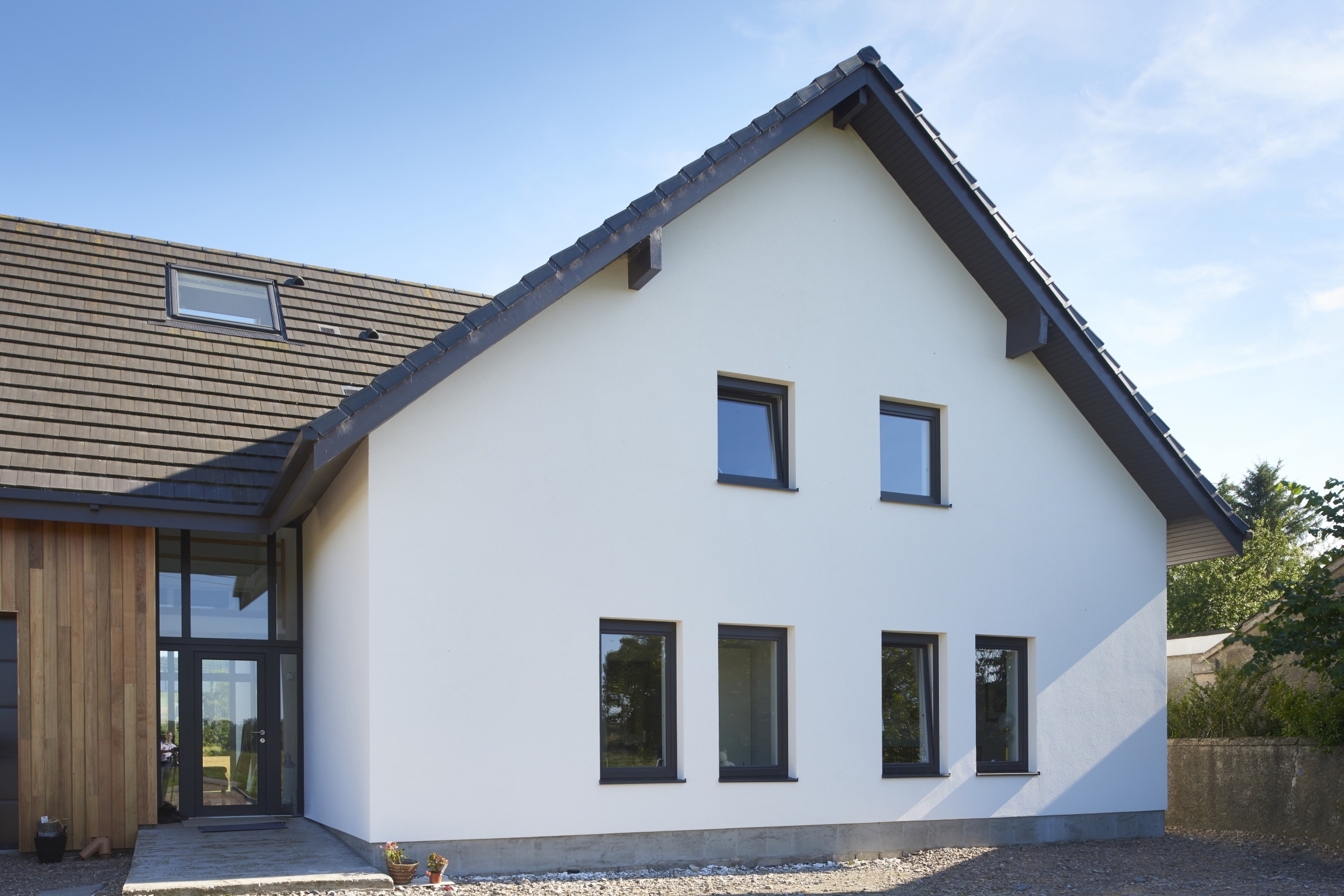
Stocking a render system that works across multiple substrates and building types makes commercial sense for any builders’ merchant. Jason Nicholson, Render Product Manager at Saint-Gobain Exterior Solutions – the brand now behind K Rend – explains why a versatile render offering will serve a wider range of customers, reduce the risk of costly specification errors and deliver repeat business.
Not all render systems are created equal. Some manufacturers offer versatile base coats that perform across different substrates including brick, block, insulation board and render board, while others require a specific product for each application.
Stocking a system with genuine breadth means your team can serve a wider range of customers without the risk of a contractor leaving with the wrong product for the job.
When a contractor comes in looking for render, the substrate is always the starting point because everything flows from that. Merchants should then establish what finish and colour is required, whether it is a new build or a refurbishment, and where the project is located.
An exposed site has very different demands from a sheltered urban plot and that will determine both product choice and application thickness. Timeline and any insulation constraints are also worth exploring early on.
“Stocking a system with genuine breadth means your team can serve a wider range of customers without the risk of a contractor leaving with the wrong product for the job.”
What sets silicone render apart
Silicone render is water repellent and breathable, unlike traditional sand and cement renders that can have a higher water absorption. This combination of properties is what sets silicone systems apart. They repel water at the surface while still allowing moisture vapour to escape from within the wall, which is a critical balance particularly in retrofit and refurbishment projects where trapped moisture can cause serious long-term problems.
Silicone based systems are through coloured, meaning the pigment runs throughout the product rather than sitting on the surface, so the finish retains its appearance far longer than paint. They require less maintenance over time and the increased flexibility of silicone-based thin coat systems reduces the risk of cracking where the product has been correctly specified.
Fewer callbacks and fewer problems further down the line is a strong message for any contractor who has dealt with render failures in the past.

Silicone renders are often perceived as a premium option. The key is to reframe the conversation around lifecycle cost. Sand and cement render requires periodic painting and scaffolding costs alone make that an expensive commitment every few years. A through coloured silicone system, properly applied, sidesteps that cycle entirely.
When you factor in scaffolding, painting and the cost of remedial repairs over five years the picture changes considerably.
Pre-mixed render systems offer real practical advantages on site. Reduced mixing time, improved consistency and faster application all contribute to more efficient installation, and for contractors working to tight schedules that reliability is worth communicating at point of sale.
Silicone renders perform particularly well in exposed locations where there is high rainfall and significant weather exposure. They also perform strongly on external wall insulation systems where a breathable, water repellent finish is essential to the long-term integrity of the whole system.
In addition, for housing association projects and large-scale residential schemes where long term, low maintenance performance is a priority, silicone renders offer a compelling case. New build and refurbishment projects both benefit, particularly where the client wants to reduce ongoing maintenance requirements.
The most frequent mistakes in render specification come down to choosing a product unsuitable for the substrate, mixing components from different manufacturers to reduce costs, and underestimating the impact of environmental exposure. Using an incompatible system can result in poor adhesion, cracking, trapped moisture and ultimately failure of the facade.
Merchants are in a strong position to prevent these problems simply by asking the right project questions, recommending compatible full systems from a single manufacturer, and directing customers to the manufacturer’s technical support when a project falls outside straightforward parameters.
Manufacturer-led support for merchants
Render manufacturers can offer merchants meaningful support beyond the product itself including technical helplines, in-store training, marketing materials, specification guidance and in some cases project lead information for schemes in the local area.
For example, the K Rend Technical Team offer regular product training courses at its Head Office in Kilwaughter, County Antrim and a purpose-built K Academy training facility in St Helens near Liverpool which provides a mix of classroom and practically-based learning.
Merchants who engage with that support and develop the confidence to have informed technical conversations are far better placed to convert enquiries into sales and build the kind of repeat business that a versatile, well-specified render system can consistently deliver.
Click here for more information about the wide range of render systems available from K Rend, now part of the Saint-Gobain Group.

K Rend is part of Kilwaughter Minerals, a quarry and minerals processor based on a 187-acre site in Larne, County Antrim. Established in 1939, the business produces calcium carbonate-based products including limestone sands, aggregates, derivative products for construction and broader industry, and a range of products for the agriculture and landscaping sectors.
Kilwaughter was recently acquired by the Saint-Gobain group.