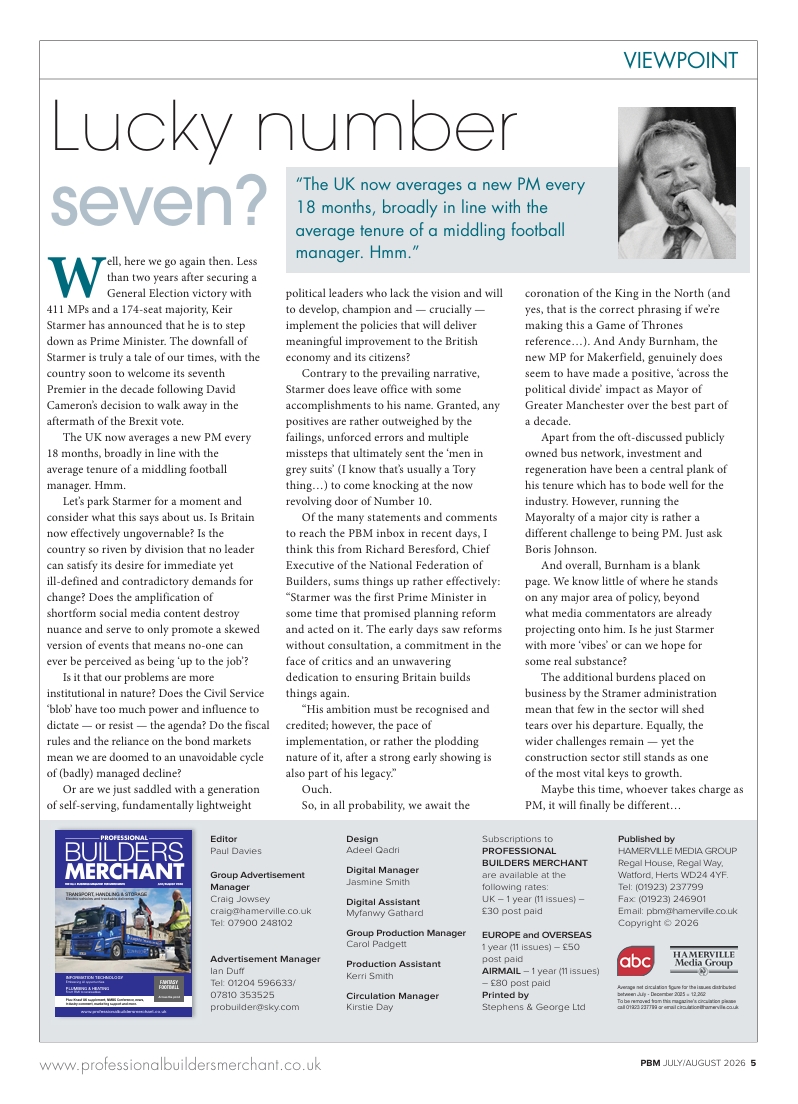


In the Viewpoint column of PBM’s July/August edition, editor Paul Davies discussed the most recent Prime Minister to fall by the wayside as political uncertainty once again threatens to destabilise any hope of economic recovery…
Well, here we go again then. Less than two years after securing a General Election victory with 411 MPs and a 174-seat majority, Keir Starmer has announced that he is to step down as Prime Minister. The downfall of Starmer is truly a tale of our times, with the country soon to welcome its seventh Premier in the decade following David Cameron’s decision to walk away in the aftermath of the Brexit vote.
In this time, the UK now averaging a new PM every 18 months, broadly in line with the average tenure of a middling football manager. Hmm.
Let’s park Starmer for a moment and consider what this says about us. Is Britain now effectively ungovernable? Is the country so riven by division that no leader can satisfy its desire for immediate yet ill-defined and contradictory demands for change? Does the amplification of shortform social media content destroy nuance and serve to only promote a skewed version of events that means no-one can ever be perceived as being ‘up to the job’?
Is it that our problems are more institutional in nature? Does the Civil Service ‘blob’ (and most specificially, the Treasury) have too much power and influence to dictate — or resist — the agenda? Do the fiscal rules and the reliance on the bond markets mean we are doomed to an unavoidable cycle of (badly) managed decline?
Or are we just saddled with a generation of self-serving, fundamentally lightweight political leaders who lack the vision and will to develop, champion and — crucially — implement the policies that will deliver meaningful improvement to the British economy and its citizens?
“In this time, the UK now averaging a new PM every 18 months, broadly in line with the average tenure of a middling football manager. Hmm.”
Contrary to the prevailing narrative, Starmer does leave office with some accomplishments to his name. Granted, those positives do seem somewhat outweighed by the failings, unforced errors and multiple missteps that ultimately sent the ‘men in grey suits’ (I know that’s usually a Tory thing…) to come knocking at the now revolving door of Number 10.
Of the many statements and comments to reach the PBM inbox in recent days, I think this from Richard Beresford, Chief Executive of the National Federation of Builders, sums things up rather effectively: “Starmer was the first Prime Minister in some time that promised planning reform and acted on it. The early days saw reforms without consultation, a commitment in the face of critics and an unwavering dedication to ensuring Britain builds things again.
“His ambition must be recognised and credited; however, the pace of implementation, or rather the plodding nature of it, after a strong early showing is also part of his legacy.”
Ouch.
So, in all probability, we await the coronation of the King in the North (and yes, that is the correct phrasing if we’re making this a Game of Thrones reference…). And Andy Burnham, the new MP for Makerfield, genuinely does seem to have made a positive, ‘across the political divide’ impact as Mayor of Greater Manchester over the best part of a decade.
Apart from the oft-discussed publicly owned bus network, investment and regeneration have been a central plank of his tenure which has to bode well for the industry. However, running the Mayoralty of a major city is rather a different challenge to being PM. Just ask Boris Johnson.
And overall, Burnham is a blank page. We know little of where he stands on any major area of policy, beyond what media commentators are already projecting onto him. Is he just Starmer with more ‘vibes’ or can we hope for some real substance?
The additional burdens placed on business by the Starmer administration mean that few in the sector will shed tears over his departure. Equally, the wider challenges remain — and the construction sector still stands as one of the keys to growth.
Maybe this time, whoever takes charge as PM, it will finally be different…