
Drawing on the findings of the recent BMF Branch of the Future report, Andrew Tavener, Head of Fleet Marketing EMEA for Descartes, considers how innovative logistics solutions such as routing and telematics technology alongside electronic proof-of-delivery tools can ensure an enhanced buying experience for all generations of trade customers.
Builders’ merchants stand at a pivotal moment in their evolution, where they must adapt to new demands and delivery expectations, or risk falling behind. Highlighting the industry’s required structural change is the BMF’s recent Branch of the Future report, written by Steve Collinge and co-sponsored by L.E.K. Consulting.
Paraphrased, it explains that customer expectations are now being reshaped by the speed, visibility and convenience of modern ecommerce as a traditional branch-led, relationship-driven model is being updated with an Amazon-style customer experience that is digital, transparent and on-demand.
For many merchants across the UK, this represents a challenge to adapt and incorporate new ways of taking orders, communicating with customers, executing deliveries and managing proof of delivery.
“How can merchants reduce mileage on deliveries, keeping costs and CO2 emissions down while meeting customer need for convenience?”
A shift in buying power
The BMF’s research is quick to point out that there is a new shift in power dynamics — increasingly driven by buyers. In the past, suppliers would decide which retailers and merchants would stock their products. They drove the market and would stipulate when orders for goods would arrive.
Thanks to ecommerce and the shopping experiences we’ve all come to appreciate, this is changing. Tradespeople are now in the driver’s seat. They have more options available, meaning they can pick and choose where to buy, specifying when and where they want materials delivered.
The report points out distinct buying requirements between generations, noting that ‘older tradespeople’, defined as Boomers (1946 – 1964) and Generation X (1965 – 1980), expect to visit a merchant to pick up goods. In comparison, ‘younger tradespeople’ often prefer a ‘Click and Collect’ or an ecommerce-like delivery experience.
It is essential for merchants to acknowledge these differences in their customers’ buying needs if they are to serve both loyal older tradespeople and foster sales with younger clients.
For instance, the BMF says the average typical builders’ merchant customer is 53 years old. Older tradespeople typically stick to well-known brands and have their preferred trusted suppliers, who they’ve used for many years. They value relationships with in-store staff and reps for quotes and advice.
They are likely to buy in bulk, stockpile materials, and depend on traditional invoicing and paperwork. Given their years of experience, they tend to understand long-term pricing trends — and expect trade discounts based on loyalty and bulk buying. They prefer traditional credit with merchants and tend to be more patient, and unlikely to try fast delivery choices.
Younger expectations
Younger tradespeople have a different approach to buying. They, too, value in-store relationships, but are more influenced by online reviews and recommendations and are more open-minded to trying new brands, based on good reviews and pricing. They are more likely to buy online, frequently, and make use of ‘just-in-time’ delivery instead of stockpiling.
Indeed, younger tradespeople expect — and will test — fast service, next-day or same-day delivery (including click & collect). Although they will also buy in-branch, they are less likely to visit as often. They understand lead times and are less patient with delays and mistakes generally.
Futureproofing
Convenience, personalisation and sustainability are some of the key factors that the branch of the future must consider. The in-store proposition remains key, with brands encouraged to create communities/hubs for exclusive demos or as meeting places for peers.
But with the importance of offering a digital / ecommerce purchasing and delivery experience via apps, web, phone or in branches, all these systems must be linked in addition to supporting access to current stock data, pricing and delivery capability.
Sustainability is increasing in importance, too. Branches are evaluating how to become more energy efficient but one area that is ripe for improvement is across merchants’ fleets of last-mile delivery vehicles. It’s one thing to offer convenience to today’s modern customer, but, how ‘green’ are deliveries? How can merchants reduce mileage on deliveries, keeping costs and CO2 emissions down while meeting customer need for convenience?
Optimising vehicle fleets
Today, routing and telematics tools enable merchants to optimise the use of their vehicle fleets. This includes using AI-enhanced algorithms to support planning teams with what orders to pack into vehicles to meet the urgent delivery requirements of tradespeople.
Effective technology integrates with ecommerce platforms seamlessly, and enables tradespeople to select the best delivery slot for themselves when ordering. This helps them with planning and can even reduce the theft of those materials, as they can be scheduled to arrive just in time for use on jobs.
Further, this technology enables merchants to select the most efficient fulfilment centres and routes for deliveries, reducing mileage, CO2 and costs.
Effective customer communication and electronic proof of delivery is an important part of the Amazon-like customer experience. After an order is placed, can the merchant confirm orders and communicate with customers via email, apps and WhatsApp?
Can tradespeople be reached if there are any delays with an order, or how can they communicate with the merchant (or driver) if a change in logistical operations is required? For instance, explaining that the delivery needs to go to ‘Gate B’ instead of ‘Gate A’ due to an accident on site that is preventing access for vehicles…
Additionally, what about when the delivery is taken, is there a way to sign for it via a mobile device using electronic proof of delivery and what is the process for seeking feedback, supporting reviews and loyalty?
Modern customer communication technology is supporting merchants as they evolve to meet changing customer needs. The future is on the merchants’ doorstep. The customers, relationships and revenue are there for the taking…
Descartes provides merchants with integrated logistics solutions, including AI‑driven route planning, fleet telematics, mobile proof‑of‑delivery and customer communication tools to optimise deliveries and enhance operational efficiency.
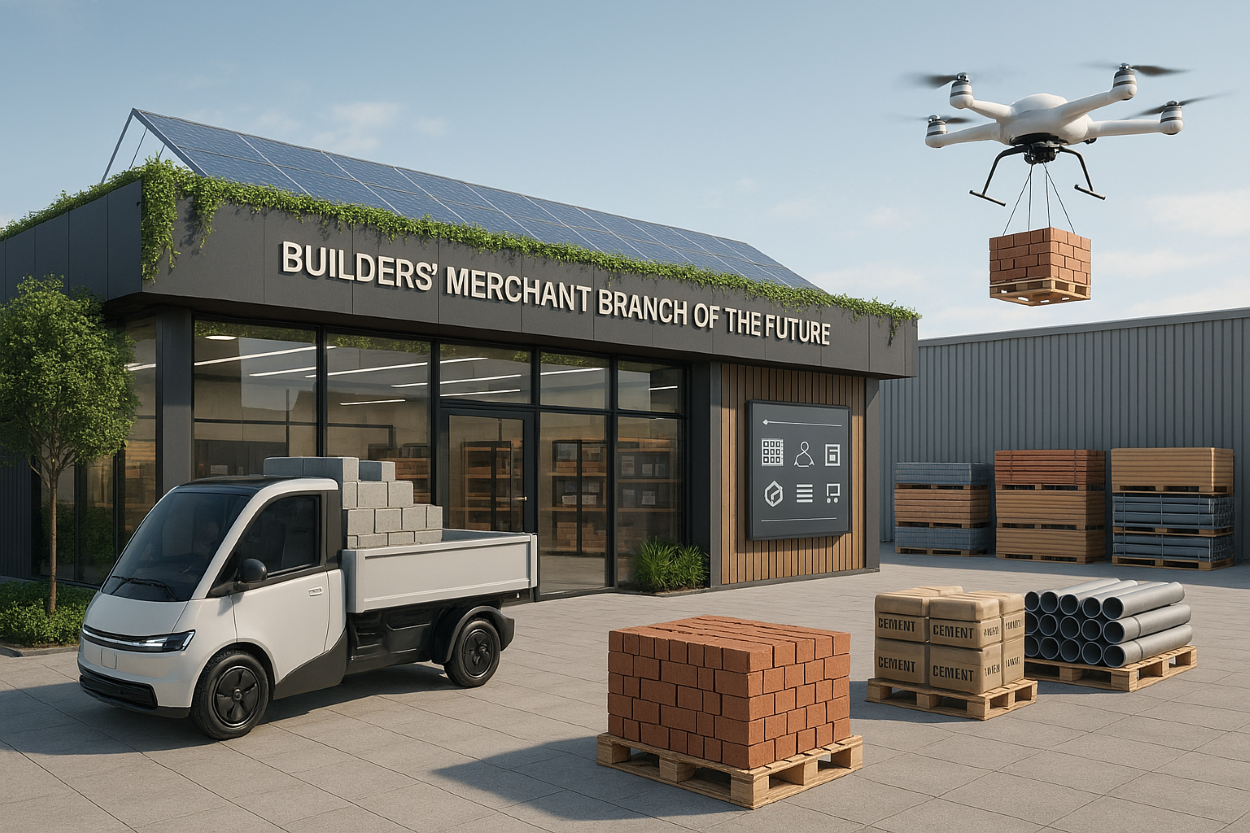
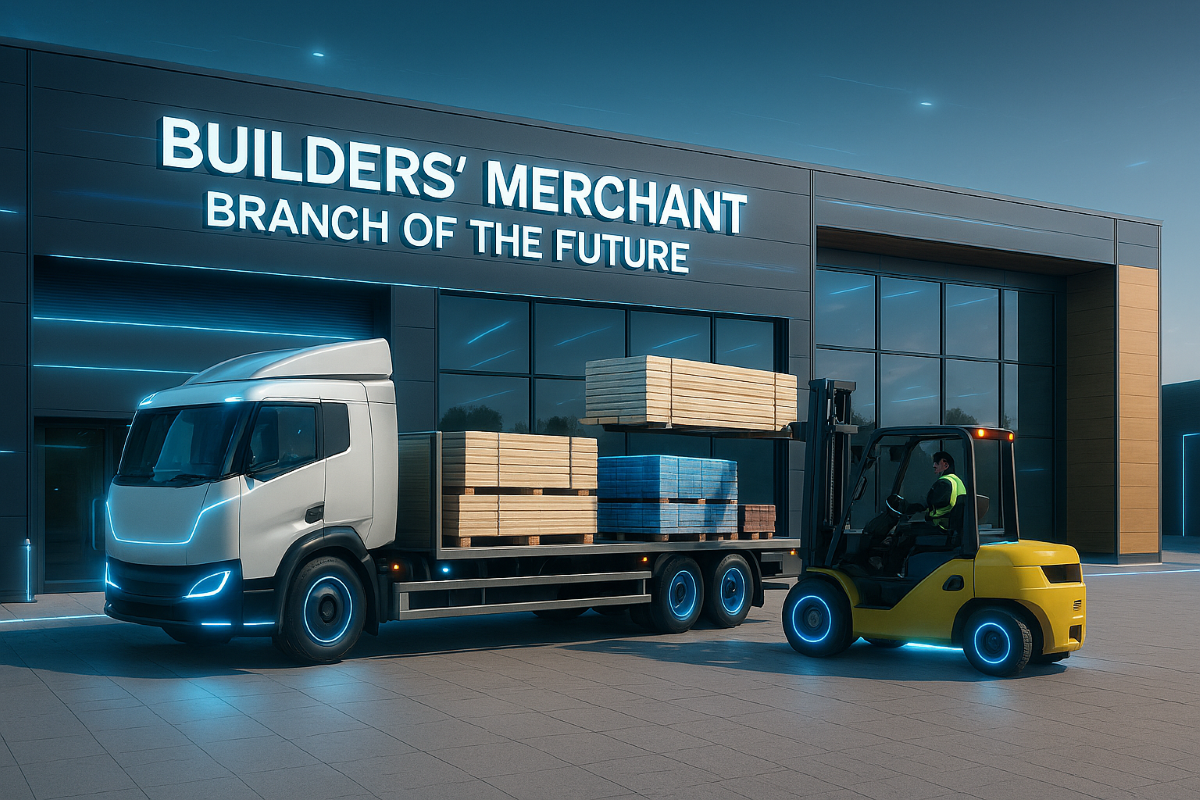
Note on main images: Perhaps a measure of what lies ahead, these are the results of an AI-prompted enquiry that simply asked what the builders’ merchant branch of the future may look like…